Panoramas to explore
5 panoramas
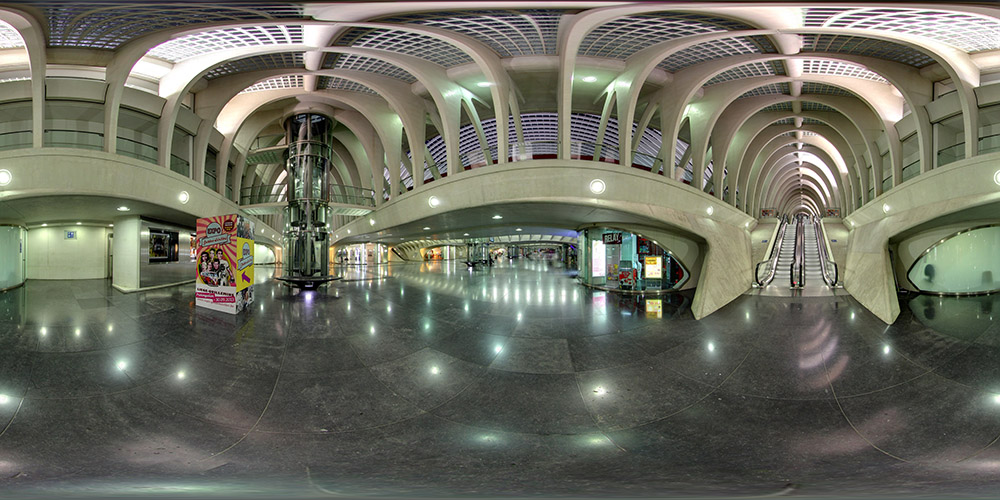
The Intermediate Level
Santiago Calatrava · 2009
Guide :
Between the street and the platforms, the station has an intermediate level that almost no one notices. Yet Calatrava treated it carefully: crossed barrel vaults in white concrete on organic columns, a long tunnel perspective. The contrast between the white vaults and the dark petit granit floor is striking. What would you like to look at: the coherence between this level and the great hall above, or what this transition space reveals about the project?
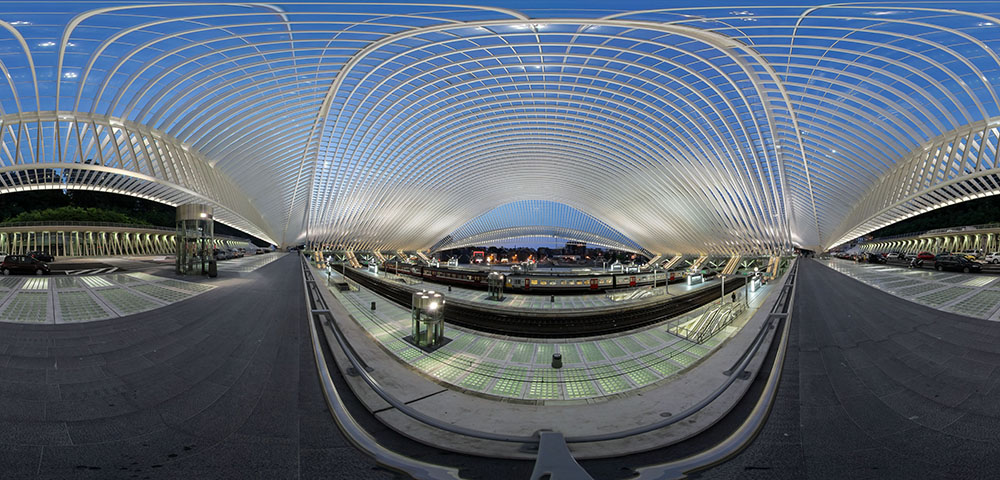
Under the Vault, at the Blue Hour
Santiago Calatrava · 2009
Guide :
You stand on one of the upper footbridges leading down to the platforms, under the great vault of Guillemins. At the blue hour, the sky pours between the arches as if nothing stood between you and it. Calatrava did not want a closed roof: he wanted a steel mesh that lets light, wind and city noise pass through. Underfoot, the polished blue stone of Wallonia. What would you like to explore: the traveller's experience under this vault, the choice of light, or what the station replaced in 2009?
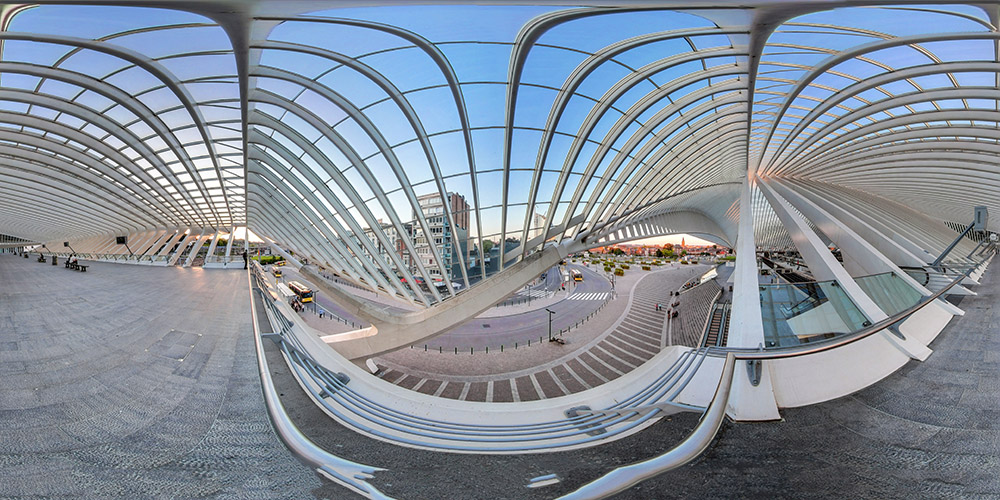
Calatrava's Skeleton
Santiago Calatrava · bureau Greisch · 2009
Guide :
You stand at the edge of a platform, the summer sky passing between the ribs of the vault. This is not a roof on columns, it is a skeleton. Calatrava is as much an engineer as he is an architect, and the signature of his stations is exactly this: white arches that look almost bone-like, somewhere between a nave and a ribcage. For the structural design he worked with the Liège-based Greisch studio. What would you like to look at: why an exposed skeleton rather than walls, what Calatrava had built before, or how this vault actually stands?
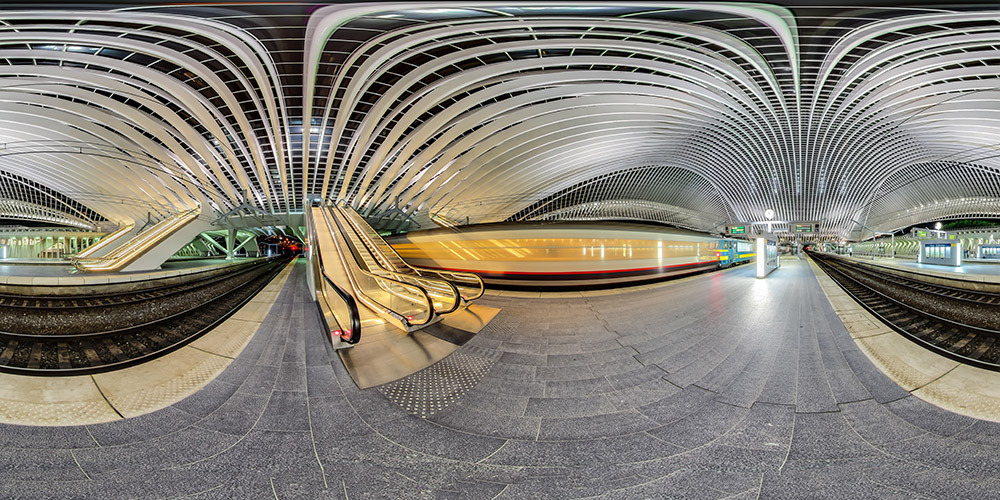
The Platform, the Train, the Escalator
Santiago Calatrava · vue de nuit en pose longue · 2009
Guide :
You stand on a platform, in the evening. A train passed during the shot: it left only a yellow-and-red streak, a ghost of motion. To your left, the escalator rises empty toward the upper footbridge. Calatrava's vault becomes here a long corridor of artificial light, almost silent. This station is mostly photographed in daylight; at night, it shifts. What would you like to look at: the long exposure, the empty station, or the fact that it remains a station even under a cathedral?
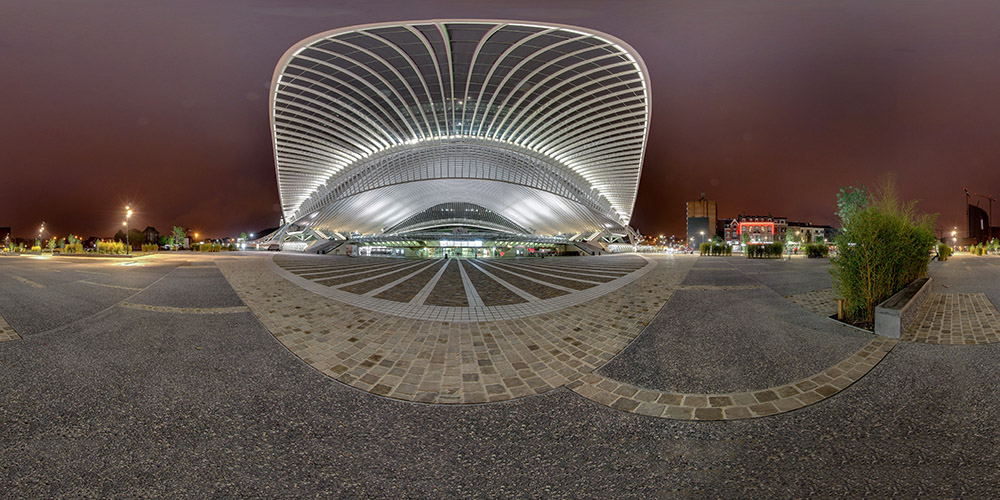
The Forecourt Without a Façade
Santiago Calatrava · vue extérieure de nuit · 2009
Guide :
You stand on the forecourt, at the foot of the station, the sky has turned purple. What faces you is not a façade: it is the prow of a vault, open, with no door, no wall. Calatrava refused to separate the station from the city with a threshold; you enter as you would cross a covered market. If you turn 180 degrees, Cointe hill and its Inter-Allied Memorial align their Art Deco silhouette with the station's axis. What would you like to look at: this forecourt as a new public square, the surrounding district, or the dialogue with Cointe?